Jaeger Le-Coultre: Horlogerie de Luxe 1938
Why 1938 Was a Defining Era for Jaeger-LeCoultre
1938 — arguably one of the finest eras in watchmaking. Especially for top watchmakers like Jaeger-LeCoultre. This period marked a pivotal transition toward the modern wristwatch, with innovations that would shape the next century of horology.
Waterproof cases, exotic movement constructions, compact calibers, early calendar mechanisms — all were taking form during this moment in time. And with design still deeply influenced by the Art Deco movement, the watches of the late 1930s were not only technically advanced but also among the most decorative.
To illustrate this unique period, here is an original 1938 Jaeger-LeCoultre brochure, a snapshot of the Jaeger-LeCoultre’s creativity, engineering ambition, and design philosophy on the eve of World War II. Within its pages, some of the most important innovations in JLC’s history come together.
Duoplan: Engineering Smallness Without Compromise
One of the brochure’s highlights is the Duoplan movement — a revolutionary construction where traditional-sized parts were arranged on two levels (“duo-plane”). This allowed Jaeger-LeCoultre to create extremely narrow watches without sacrificing accuracy or durability.
The Duoplan set the foundation for JLC’s mastery of compact calibers and elegant case design, and would influence the maison for decades to come.
Calibre 101: The Pinnacle of Miniaturisation
In the ladies’ segment, we see the legendary Calibre 101 — still the smallest mechanical movement ever made.
Introduced in 1929, it offered an unprecedented combination of elegance, wearability, and engineering complexity.
The Reverso: Functional Elegance Meets Art Deco Design
Also present is the now-iconic Reverso — originally designed for polo players who needed their watch crystal protected during matches.
With improved shock resistance, a reversible case, and that unmistakable Art Deco geometry, the Reverso of the late 1930s represents one of the most timeless designs in watchmaking history. Its presence in the brochure shows just how relevant it already was, only seven years after its introduction.
Étanche: The Pursuit of True Waterproofness
Water resistance was one of the most sought-after features of the 1930s, and Jaeger-LeCoultre was at the forefront. The brochure includes multiple Étanche (waterproof) models, showcasing the maison’s early exploration of hermetically sealed cases, screw-down backs, and improved gasket systems.
For more on the evolution of waterproofing, see my dedicated article: The waterproof wristwatch of 1941
Calendars, Chronographs & Uniplans
The brochure also highlights JLC’s expanding range of functional complications:
Early calendar watches, precursors to the refined triple-calendar references of the 1940s.
High-quality chronographs, illustrating JLC’s technical versatility.
The maison’s signature Uniplan designs — elegant round and rectangular watches defined by slim geometry and clean lines.
These pieces show how broad JLC catalogue.
Accessories, Travel Clocks & the Atmos
Beyond wristwatches, the booklet includes:
Chatelaines and clips, beautifully crafted pocket-watch alternatives for ladies
Elegant travel clocks with integrated alarms
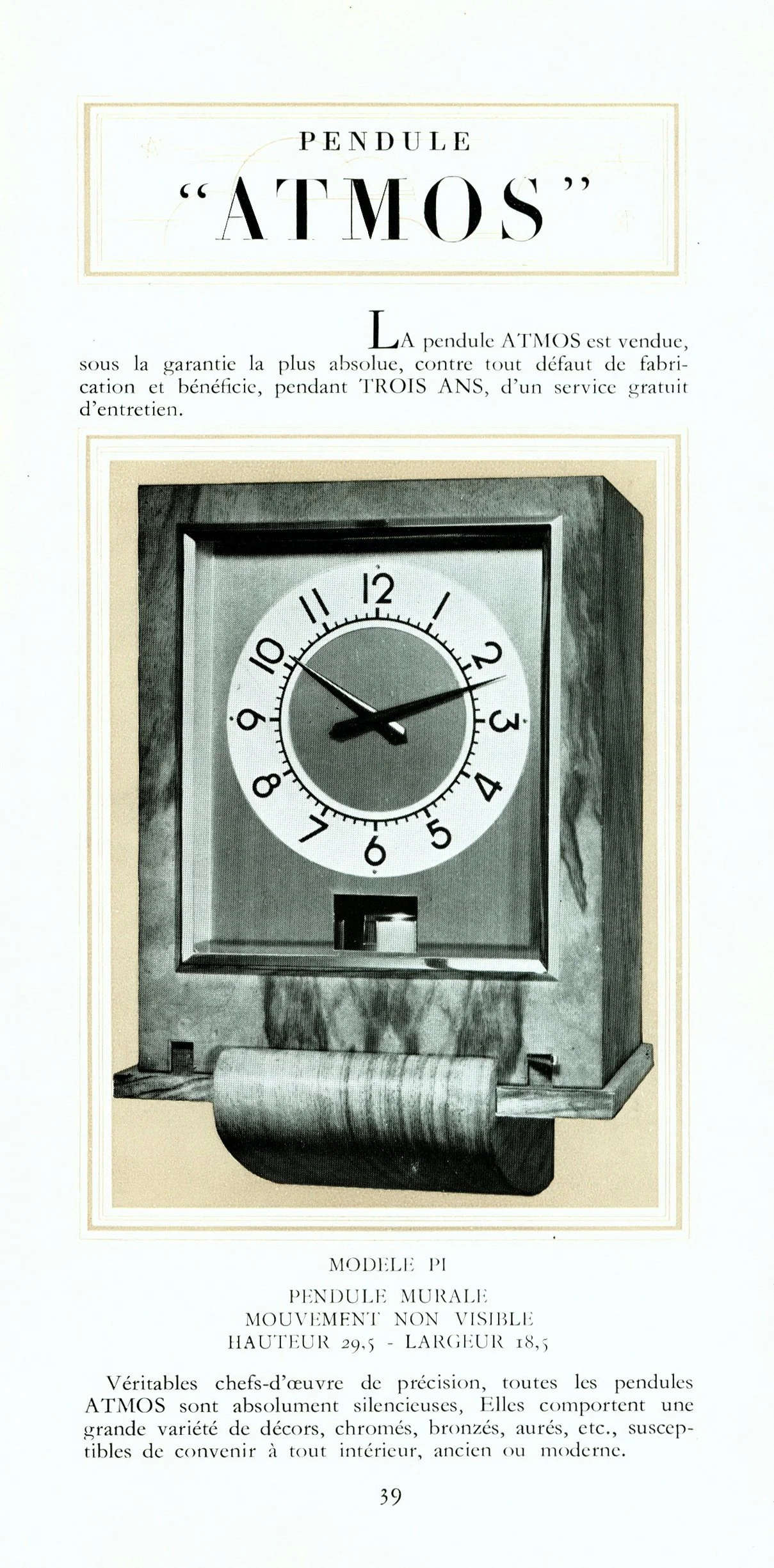
And of course, the Jaeger Atmos — already positioned as a technical marvel, capable of running “almost perpetually” from changes in temperature and atmospheric pressure
Together, they reflect JLC’s identity not just as a watchmaker but as a complete horological manufacture.